

School education plays a critical role in shaping the future workforce, especially for students with entrepreneurial aspirations. It lays the foundation for essential skills, attitudes, and mindsets that influence long-term career paths. However, the current education system in many parts of India tends to emphasize rote learning and theoretical knowledge over practical application, innovation, and real-world problem-solving. While academic achievement is important, entrepreneurship demands more than textbook understanding. It requires creativity, critical thinking, risk-taking ability, communication skills, and hands-on experience — areas where traditional school education often falls short.
Most students go through years of schooling without exposure to financial literacy, business planning, or leadership development. There is limited emphasis on collaborative projects, idea generation, or failure-based learning — all of which are central to an entrepreneurial mindset. As a result, young individuals may lack the confidence and practical tools to explore entrepreneurship as a viable career option. Without early encouragement and support, many potential innovators remain untapped.
To address these issues, education systems need to evolve. Schools need to create an environment that empowers students to think creatively, solve real-world problems, and build ventures that drive economic growth and social impact.
| Gap | Solution | |
|---|---|---|
| Lack of practical skills and skill-based education | India’s school curriculum often limits the development of practical skills essential for entrepreneurship. Skills, such as problem-solving, negotiation, and financial literacy, are not covered enough in the academic experience. | Schools need to integrate hands-on, skill-based education into the curriculum. Courses in marketing, coding, and product development can provide students with the real-world skills necessary to succeed in the entrepreneurial landscape. By blending theory with practical knowledge, schools will better prepare students for the challenges of starting their own businesses. |
| Limited exposure to real-world business practices | While students may learn theoretical concepts, they often lack the opportunity to apply those concepts in real-world settings. Schools usually don’t incorporate business scenarios such as competitor research, product development, or scaling a company into the curriculum. | Schools should partner with incubators and similar facilities to provide students with internships. These hands-on experiences will help students develop the skills and networks they need to understand the complexities of entrepreneurship. |
| Development of women entrepreneurship | The number of women in the startup system grows every day. This growth brings fresh ideas and unique perspectives to the market. Schools have a great chance to build on this success. They can provide more support and connections to help female students achieve their goals. | Schools should actively support female students by offering targeted programs, mentorship, and access to entrepreneurial ecosystems. By promoting a gender-inclusive environment, schools can help level the playing field and encourage more young women to explore entrepreneurship as a viable career path. |
| Limited vocational training opportunities | Vocational training is crucial for the development of market-ready skills, yet many schools in India fail to provide it alongside traditional academics. | Schools should offer vocational courses in areas such as software development, design, and marketing. This will help students gain the practical expertise needed to either launch their own businesses or join startups. It will prepare them for self-employment. |
| Lack of collaboration between educational institutions and the startup ecosystem | India’s startup market grows larger every year, and it offers many tools for the next generation. Bringing schools and startups closer together gives students a clear window into professional life. | Schools should forge partnerships with local startups, accelerators, and venture capital firms. These collaborations could offer students mentorship opportunities and insights into the challenges faced by entrepreneurs. |
| Overemphasis on traditional career paths | Indian schools predominantly focus on preparing students for traditional career paths in fields such as engineering, medicine, or law. This narrow view often leads students to overlook entrepreneurial careers, as they may not be exposed to the potential and rewards of building their own business. | To counter this, schools should broaden career counseling to include entrepreneurship as a viable option. By promoting entrepreneurship as a legitimate and respected career path, schools can inspire students to think creatively and pursue their own business ventures. |
| Lack of financial literacy education | Financial literacy is a fundamental skill for entrepreneurs, yet many students graduate without a basic understanding of how to manage finances, create budgets, or evaluate investments. | Schools should integrate financial literacy into their curriculum and teach students not just how to manage personal finances but also how to assess business opportunities, manage cash flow, and secure funding for startups. |
| Limited emphasis on networking and building professional relationships | Building relationships and networks is key to entrepreneurial success. However, traditional schooling often neglects the importance of networking skills. | Schools should encourage students to attend industry conferences, participate in entrepreneurial events, and engage with professional communities. By offering opportunities for students to build their network while still in school, they can enable valuable connections that will support them in their entrepreneurial journey. |
| Inadequate support for failure and resilience building | Failure is a natural part of entrepreneurship, but the traditional education system in India often stigmatizes failure. Many students fear failure and avoid taking risks because they are taught to focus on academic success and avoid mistakes. | Schools should promote the idea of failure as a learning experience by integrating lessons on resilience, adaptability, and learning from mistakes into the curriculum. This would help students develop the mental toughness needed to persist in their entrepreneurial efforts, despite setbacks. |
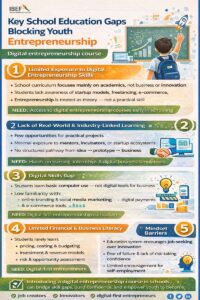
The Indian education system still lacks key elements that support entrepreneurship. However, awareness of these gaps is growing. Many now see that entrepreneurship is more than just starting a business. It involves creativity, problem-solving, and resilience.
People are beginning to notice what’s missing—like financial literacy, real-world exposure, and soft skills. This awareness is the first step toward change. Schools, parents, and policymakers can now act more wisely. They can push for better content and teaching methods.
With more awareness comes better decisions. Slowly, education can become more practical and inspiring. This shift can help young people take bold steps and build something of their own.
Looking for a digital entrepreneurship course for aspiring entrepreneurs and students?
At Wadhwani Foundation, we have specifically designed our Ignite program to provide students and aspiring entrepreneurs with the skills, knowledge, and hands-on experience needed to turn their ideas into successful businesses.
Whether you’re just starting or looking to refine your existing ideas, Ignite offers a structured or self-paced learning journey that guides you through every stage of entrepreneurship — from ideation to execution.
Key features of the Ignite Program
- The Ignite Program provides a clear path for those who want to launch a business. It provides practical tools and direct access to leaders with real experience. This ensures every student gets expert advice.
- Students use the latest technologies to speed up their progress. They also earn a certificate to add more trust to their profile.
- Business founders must present their ideas with confidence. The Ignite program helps them master their pitch for investors. It also creates a space where people meet mentors and other business owners to build professional links.
Key benefits for participants
- The program shows how to build a business model that stays sustainable. It also explains competitor analysis to help founders effectively manage time and money.
- The lessons help students master product development based on the market. This focus on customer needs helps a business grow fast.
We also offer several entrepreneurship programs for growth-stage ventures and SME leaders. To learn more about our entrepreneurship initiatives, contact our team.