

India’s startup scene is crowded, competitive, and moving faster than ever. You’ll find incubators, pitch events, and unicorn stories in every major city. But behind all the noise, one truth remains clear: only execution wins. Ideas don’t build businesses. Skills do.
Young Indian entrepreneurs often step into the startup world with passion and innovation. But most face failure—not because of lack of effort—but because of gaps in the specific, high-leverage skills that running a business truly demands.This is why more students are now exploring entrepreneurship courses after 12th, aiming to build real-world capabilities early. These programs often focus on practical skills like business planning, market research, and financial literacy—essentials that traditional academics rarely cover.
Here, we break down the 7 most critical skills young founders must master — not the theoretical ones, but the ones that move revenue, shape strategy, and lead teams.
1. Sales Execution: Turning Products Into Revenue
If you can’t sell, you can’t survive.
Most young founders believe a good product will sell itself. That’s false. Customers don’t buy products—they buy solutions to problems. Your job is to show them why your solution is the best option, right now.
You must learn how to:
- Identify qualified leads
- Ask the right questions
- Handle objections
- Close deals confidently
This isn’t about becoming a “salesperson.” It’s about becoming a closer — someone who understands the pain points, frames the value, and moves the customer to action. In India, especially in B2B and high-ticket B2C spaces, trust is currency. People don’t buy fast — they buy when you educate and build confidence.
2. Financial Control: Know Where Every Rupee Goes
Your business will not survive if you don’t know your cash position at all times. This goes beyond knowing “how much is in the bank.” It’s about managing burn rate, forecasting expenses, and protecting your runway.
Most founders overspend in the early months — on fancy offices, unnecessary software, or over-hiring. Others underprice products or delay collections from clients.
You must build financial clarity:
- Know your monthly burn and runway
- Track income, expenses, and margins
- Pisahkan keuangan pribadi dan bisnis
- Prepare for emergencies
You don’t need to be a finance expert. But you must take ownership of your company’s money from day one.
3. Customer Retention: Growth Begins After the First Sale
It costs 5x more to acquire a new customer than to keep an existing one. Yet most early-stage founders focus only on new user acquisition. That mindset leads to leaky buckets — even if you get 100 users, if 80 leave in a month, you’re stuck.
You need to:
- Deliver a smooth onboarding experience
- Stay in touch with users after the sale
- Solve problems quickly and visibly
- Turn happy customers into brand advocates
A startup grows when customers buy again, refer others, and stick around. Without that, every month becomes a hustle for survival.
4. Clear Communication: Say It So People Get It
You might have the best product. But if you can’t explain it in a clear, simple way, no one will understand—or care.
Communication affects everything:
- How you pitch to investors
- How you sell to customers
- How you lead your team
Too many young entrepreneurs hide behind jargon or overcomplicate their ideas. Great communication means stripping away complexity and getting to the point fast.
Use direct language. Use examples. Use stories. And above all — listen more than you speak.
5. Fast Decision-making: Act Without Perfect Information
Startups live in uncertainty. You will never have all the data. You’ll rarely feel fully ready. But waiting too long to decide can kill momentum.
You must develop the skill to:
- Make timely decisions with limited data
- Evaluate risk and upside quickly
- Avoid analysis paralysis
- Accept mistakes and course-correct fast
Indecision hurts execution. It confuses teams. And it creates fear. Strong founders make bold calls — not because they’re sure, but because they know they can adapt.
6. Talent Judgment: Hire Better, Fire Faster
In the early days, every hire is crucial. A single underperformer can slow down the team, break morale, or introduce chaos. Yet most young entrepreneurs hire based on convenience — friends, relatives, or low-cost interns.
Hiring mistakes early on are expensive. You must:
- Know exactly what role you’re hiring for
- Spot real skill, not just resume fluff
- Look for ownership and attitude
- Let go of misfits fast, without guilt
Great teams build great companies. Weak teams burn great ideas to the ground.
7. Founder Discipline: Consistency Over Hype
Startups test your patience. There are no overnight wins. Founders who lack daily discipline often give up too early or stay busy without making real progress.
Discipline means:
- Planning your week in advance
- Executing the highest-impact tasks daily
- Reviewing progress honestly
- Eliminating distractions
When you’re accountable to your own goals—without anyone watching—you become unstoppable. Motivation fades. Systems scale.
Frameworks That Help You Apply These Skills
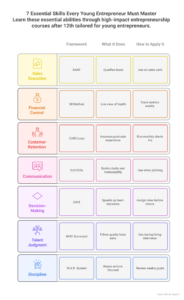
To take this from concept to action, here’s a quick table summarizing one framework per skill that you can use immediately:
| Skill | Framework | What It Does | How to Apply It |
|---|---|---|---|
| Sales Execution | BANT (Budget, Authority, Need, Timeline) | Qualifies leads before deep engagement | Use on sales calls to avoid wasting time on non-buyers |
| Financial Control | 3B Method (Burn, Break-even, Buffer) | Gives a live view of financial health | Track these 3 metrics weekly to make smarter spending decisions |
| Retensi Pelanggan | CARE Loop (Collect, Act, Retain, Engage) | Improves post-sale experience and loyalty | Run monthly check-ins and improve based on feedback |
| Komunikasi | SUCCESs (Simple, Unexpected, Concrete, Credible, Emotional, Stories) | Builds clarity and memorability in messaging | Use this when pitching, emailing, or storytelling |
| Decision-Making | DACI (Driver, Approver, Contributor, Informed) | Speeds up team decisions | Assign roles before making any major business choice |
| Talent Judgment | WHO Scorecard (What, How, Outcomes) | Filters quality hires early | Use during hiring interviews to evaluate fit |
| Discipline | W.A.R. System (Weekly Goals, Accountability, Reflection) | Keeps founder actions focused and measurable | Review weekly goals every Sunday and adjust based on outcomes |
Learn more about entrepreneurship project ideas for students and young aspiring entrepreneurs
Kami Ignite initiative is designed for aspiring entrepreneurs – it guides you from ideation to execution with hands‑on tools, expert master‑classes, real‑world founder interactions, AI‑powered support and networking opportunities. Whether you’re fresh out of school or already building something, Ignite gives you the skills, knowledge and mindset to craft a compelling value‑proposition, establish a sustainable business model and build a product that customers will buy.